HMO Mortgage Lenders: UK Guide for Multi-Let Landlords
Houses in multiple occupation represent a lucrative yet complex segment of the UK rental market, and financing these properties requires a fundamentally different approach from standard buy-to-let investments. HMO mortgage lenders apply distinct underwriting criteria because these multi-let properties carry unique regulatory, compliance and income characteristics that demand specialist assessment. Understanding which lenders operate in this space, what they require, and how their processes differ is essential for landlords building or expanding HMO portfolios in 2026.
Why HMO Mortgages Differ From Standard Buy-to-Let
HMO mortgage lenders treat multi-let properties as a separate asset class for good reason. The regulatory framework surrounding houses in multiple occupation is significantly more demanding than single-let properties.
Licensing and Regulatory Complexity
Mandatory HMO licensing applies to properties occupied by five or more people forming more than one household, who share facilities such as bathrooms or kitchens. Many local authorities have also introduced additional and selective licensing schemes that capture smaller HMOs. Lenders recognise that unlicensed properties expose them to considerable risk, including civil penalties under housing legislation and the possibility that landlords face Rent Repayment Orders.
Key licensing considerations that HMO mortgage lenders assess:
- Whether the property requires a mandatory licence under current thresholds
- Existence of additional or selective licensing in the local authority area
- Compliance with the Management of Houses in Multiple Occupation Regulations
- Evidence that all prescribed standards are met before completion
The detailed guidance from Shelter England illustrates just how varied licensing requirements can be across different council jurisdictions, and lenders must account for this regional variation when underwriting applications.

Income Assessment and Stress Testing
Unlike standard buy-to-let mortgages where a single tenancy generates the income, HMO mortgage lenders must evaluate multiple rental streams from several tenants. This creates both opportunity and complexity.
Most specialist lenders will assess rental income using one of two methods:
- Individual room rates – calculating the actual rental income from each lettable room
- Portfolio stress testing – applying higher interest coverage ratios to account for void periods and tenant turnover
The stress testing applied by HMO mortgage lenders is typically more rigorous than standard buy-to-let products. Where a single-let might require rental income to cover interest costs at 125% when stressed at a notional rate, HMO products often demand 145% coverage or higher. This reflects the greater volatility inherent in managing multiple tenancies simultaneously.
Types of HMO Mortgage Lenders in the UK Market
The landscape of HMO mortgage lenders has evolved considerably over recent years, with an increasing number of institutions recognising the sector's potential. Understanding which type of lender suits your circumstances helps narrow your search efficiently.
Specialist Buy-to-Let Lenders
These institutions focus exclusively on investment property and have developed dedicated HMO underwriting teams. They understand the nuances of multi-let properties and typically offer the most flexible criteria.
Specialist HMO mortgage lenders in this category often accept properties that high-street banks would decline, including larger HMOs with six or more bedrooms, properties requiring refurbishment, and conversions that need planning permission or building regulation approval.
| Lender Type | Typical Max LTV | Portfolio Landlords | New Builds | Refurbishment |
|---|---|---|---|---|
| Specialist buy-to-let | 75-80% | Yes | Selective | Yes, often separate product |
| Building societies | 65-75% | Case by case | Limited | Rarely |
| Challenger banks | 70-75% | Yes | Yes | Case by case |
| High street banks | 60-70% | Limited | Yes | No |
Building Societies and Regional Lenders
Several building societies have entered the HMO market, though their criteria tend to be more conservative than pure specialist lenders. The Leeds Building Society lending criteria provides a useful example of how these institutions structure their HMO products, often requiring evidence of landlord experience and limiting the number of HMO properties within a portfolio.
Building societies typically favour smaller HMOs (five or six occupants) in good condition with established licensing in place. They may decline properties that require significant conversion work or that sit in areas with complex local licensing schemes.
Challenger Banks and Alternative Lenders
The challenger bank sector has brought innovation to HMO mortgage lending, with some institutions offering products specifically designed for professional landlords managing larger portfolios. These lenders often leverage technology to speed up application processes and may accept properties that fall outside mainstream criteria.

What HMO Mortgage Lenders Require From Applicants
Beyond the property itself, HMO mortgage lenders scrutinise the landlord's experience, financial position and management capabilities. The requirements have become increasingly stringent as the sector has matured.
Landlord Experience and Track Record
Most HMO mortgage lenders impose minimum experience requirements. A typical specialist lender might accept first-time landlords for smaller HMOs (five beds) but require at least two years of buy-to-let experience for properties with seven or more occupants.
Common experience thresholds:
- First-time landlord: 3-5 bed HMO only, often requiring previous homeownership
- 1-2 years buy-to-let: Up to 6 bed HMO, may require HMO-specific experience
- 3+ years buy-to-let: Larger HMOs accepted, portfolio products available
- 5+ years HMO experience: Access to most competitive rates and highest LTVs
Some lenders will accept newly qualified landlords if they can demonstrate professional property management or relevant qualifications, such as accreditation through a landlord association scheme.
Property Condition and Compliance Documentation
HMO mortgage lenders require comprehensive evidence that properties meet all regulatory standards before releasing funds. The detailed property criteria guide from The Mortgage Lender illustrates the level of documentation now standard across the sector.
Essential documentation includes:
- Current HMO licence (or evidence that one is not required, with detailed justification)
- Valid gas safety certificate (renewed annually)
- Electrical Installation Condition Report (EICR) showing satisfactory condition
- Energy Performance Certificate (EPC) at minimum required rating
- Fire risk assessment and evidence of compliant fire precautions
- Floor plans showing room sizes meet minimum space standards
Managing compliance certificates across your property portfolio becomes increasingly important as you scale, and many landlords find that systematic tracking prevents delays when approaching HMO mortgage lenders for refinancing or expansion.
Financial Assessment and Affordability
Personal income requirements for HMO mortgage lenders vary significantly. Some specialist lenders have no minimum income requirement, assessing the application purely on the property's rental yield. Others impose thresholds, particularly for larger loans or portfolio landlords.
Portfolio landlords-those with four or more mortgaged buy-to-let properties-face additional scrutiny under rules introduced following regulatory reviews. The FCA's discussion paper on mortgage market evolution provides context on how these requirements continue to develop, affecting how HMO mortgage lenders assess applications from landlords with multiple properties.
How to Choose the Right HMO Mortgage Lender
Selecting from the available HMO mortgage lenders requires careful analysis of your specific circumstances, property characteristics and long-term strategy. The cheapest headline rate rarely delivers the best overall outcome.
Matching Lender Criteria to Your Property
Start by categorising your property against common lender criteria points:
Property size and configuration
- Number of lettable rooms and total occupancy
- Whether rooms meet minimum size standards
- Shared facilities and their condition
- Whether any structural alterations are required
Location and licensing
- Local authority licensing requirements (mandatory, additional, selective)
- Whether the area has Article 4 directions limiting HMO conversions
- Local market rental demand and void periods
- Proximity to transport, universities or employment centres
Properties in areas with complex licensing or those requiring significant works typically need specialist HMO mortgage lenders rather than mainstream providers. Conversely, a well-maintained five-bed HMO in a straightforward licensing area opens access to a broader range of lenders, often at more competitive rates.
Rate vs. Flexibility Trade-Offs
The most competitive rates from HMO mortgage lenders often come with the strictest criteria. Understanding which features matter for your strategy helps you prioritise.
| Feature | Competitive Rate Lenders | Flexible Specialist Lenders |
|---|---|---|
| Interest rate | Lower (often 1-1.5% cheaper) | Higher but more accessible |
| Maximum LTV | 75% typical | 80% sometimes available |
| Arrangement fees | Lower | Higher |
| Property condition | Must be compliant | May accept refurb/works |
| Landlord experience | Stricter requirements | More lenient |
| Early repayment | Standard charges | May be higher |
If you plan to refurbish or convert a property into an HMO, choosing a lender that allows works during the initial term-even at a higher rate-may prove more cost-effective than bridging finance followed by refinancing. Similarly, if you anticipate selling or refinancing within a few years, a product with lower early repayment charges might outweigh a slightly higher rate.

Working With Specialist Brokers
The HMO mortgage market includes numerous lenders that do not accept direct applications, operating exclusively through intermediaries. Specialist brokers who focus on multi-let properties maintain relationships with the full range of HMO mortgage lenders and understand each institution's current appetite and criteria nuances.
A knowledgeable broker can:
- Identify which lenders will accept your specific property and circumstances
- Present your application in the format each lender prefers
- Navigate complex cases involving portfolio landlords or unusual property configurations
- Negotiate on terms such as valuation requirements or conditions
- Save considerable time by avoiding unsuitable lenders
The broker market itself has specialised, with some focusing exclusively on HMO and multi-unit properties. These specialists often secure access to exclusive products or preferential terms not available through generalist brokers.
Portfolio Growth and Long-Term Lender Relationships
For landlords building substantial HMO portfolios, the relationship with your lenders becomes a strategic asset rather than a transactional arrangement. The private rented sector statistics from ONS show continued growth in the multi-let segment, and positioning yourself favourably with HMO mortgage lenders supports sustainable expansion.
Portfolio Lending Facilities
Several HMO mortgage lenders now offer portfolio facilities that finance multiple properties under a single facility rather than individual mortgages. These products can streamline refinancing, reduce legal costs, and sometimes unlock better overall rates once you reach a certain portfolio size.
Portfolio facilities typically require:
- Minimum portfolio value (often starting at three to five properties)
- Demonstrated management capability across the existing portfolio
- Strong rental coverage across the portfolio as a whole
- Regular financial reporting to the lender
The underwriting process examines your entire portfolio's performance, so maintaining excellent records of rental income, void periods, and systematic rent collection processes becomes increasingly important as you scale.
Refinancing Strategy and Market Timing
HMO mortgage lenders review their criteria regularly in response to regulatory changes, market conditions, and their own risk appetite. What one lender declines today, another may accept tomorrow, and a lender that was competitive six months ago may have withdrawn from certain property types.
Successful portfolio landlords typically:
- Review their mortgage arrangements at least annually
- Maintain relationships with multiple lenders and brokers
- Build equity through capital repayment to access better LTVs over time
- Time refinancing to coincide with license renewals or property improvements
- Stay informed about regulatory changes affecting lender appetites
The Building Societies Association guidance on mortgage instructions provides insight into how these institutions approach lending decisions, useful context when planning your refinancing timeline.
Regulatory Compliance and Lender Risk Assessment
HMO mortgage lenders increasingly incorporate regulatory compliance into their ongoing relationship management, not just initial underwriting. The consequences of non-compliance extend beyond local authority enforcement to include potential mortgage covenant breaches.
Licensing Breaches and Mortgage Implications
Operating an unlicensed HMO where licensing is required constitutes a criminal offence. Beyond the direct penalties, guidance on Rent Repayment Orders shows how tenants can reclaim rent paid during periods of non-compliance, potentially lasting up to two years.
From a lender's perspective, licensing breaches represent:
- Increased repossession risk if rental income must be repaid
- Potential property devaluation if sold with enforcement history
- Reputational risk if financing properties operated illegally
- Portfolio contagion risk for landlords with multiple properties
Most mortgage terms now include explicit requirements that landlords maintain all necessary licenses and comply with regulatory standards. Breach of these covenants can trigger review or, in serious cases, demand for immediate repayment.
Ongoing Compliance Monitoring
Some HMO mortgage lenders have introduced systematic compliance monitoring for their loan books, particularly for larger portfolio landlords. This might include:
- Annual confirmation of renewed licenses
- Evidence of current safety certificates
- Tenant occupancy details to verify compliance with licensing thresholds
- Local authority correspondence regarding any enforcement issues
Maintaining organized records of all compliance documentation streamlines these reviews and demonstrates professional management to your lenders. As portfolios grow, many landlords invest in property management systems that track compliance requirements systematically, reducing the administrative burden and mitigating oversight risks.
Managing Your HMO Portfolio for Lender Confidence
The distinction between acceptable and excellent HMO mortgage applications often lies not in the property itself but in how the landlord demonstrates their management capability and financial control. For landlords building professional HMO portfolios, showing lenders that you operate systematically can unlock better terms and smoother applications.
Lenders want evidence that you can manage the operational complexity of multiple tenancies while maintaining compliance and financial stability. This means having robust systems for rent collection, maintenance coordination, void management, and financial reporting. When properties are well-managed with clear documentation, lenders perceive lower risk and respond with more favourable terms.
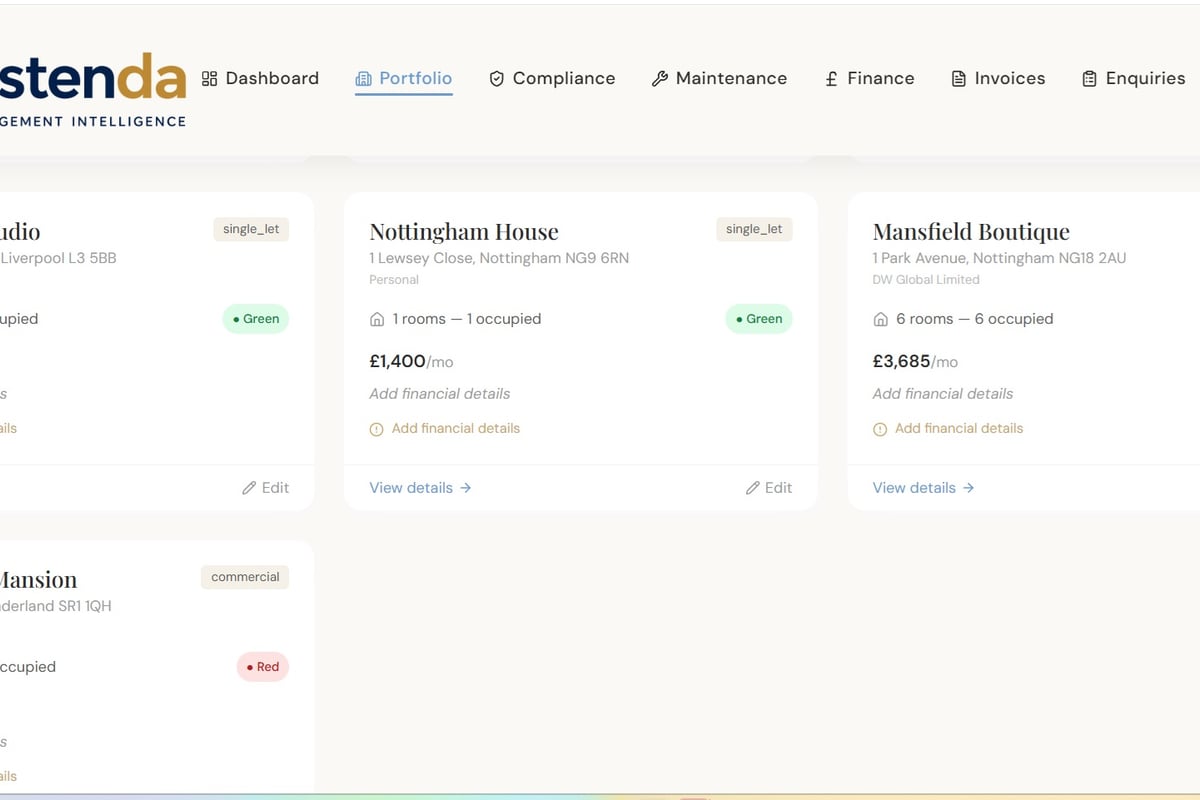
Astenda was built by an experienced HMO landlord who understands exactly what lenders look for. The Growth package helps landlords track compliance certificates, monitor rent collection across multiple tenancies, and generate the clear financial reports that HMO mortgage lenders require during applications and annual reviews.
Financial Reporting and Rent Collection
HMO mortgage lenders assess rental income sustainability closely, looking beyond headline yields to understand void patterns, arrears management, and seasonal variations. Professional landlords maintain detailed records that can demonstrate:
- Consistent rent collection rates across their portfolio
- Average void periods and how they compare to local market norms
- Arrears management processes and recovery rates
- Tenant turnover patterns and their impact on income stability
When approaching lenders for new finance or refinancing, being able to produce comprehensive rental histories strengthens your application significantly. Lenders can see that you manage properties professionally rather than reactively, reducing their perceived risk.
Maintenance and Property Condition
Deferred maintenance represents one of the primary concerns for HMO mortgage lenders. A property that appears profitable today but carries hidden maintenance liabilities may quickly become unviable, threatening the security of the loan.
Demonstrating proactive maintenance management includes:
- Scheduled inspection regimes for all properties
- Planned preventative maintenance programs
- Rapid response to tenant-reported issues
- Budget allocation for major works and lifecycle replacements
- Contractor management systems ensuring quality and compliance
Properties maintained to high standards command better rents, experience lower void periods, and attract better quality tenants-all factors that HMO mortgage lenders value when assessing applications. Regular investment in property condition also protects capital values, supporting future refinancing at attractive loan-to-value ratios.
Common Pitfalls When Approaching HMO Mortgage Lenders
Even experienced landlords can encounter obstacles in the HMO mortgage application process. Understanding common issues helps you avoid delays and declined applications.
Inadequate Licensing Documentation
Applying for HMO finance without current licensing in place is the single most common cause of declined applications. Some landlords assume they can obtain licenses after securing finance, but virtually all HMO mortgage lenders require evidence of licensing before completion.
Plan licensing applications well in advance:
- Research local authority requirements at least six months before seeking finance
- Submit license applications early, as processing times can extend to several months
- Ensure properties meet all standards before the licensing inspection
- Obtain licenses before instructing valuers or solicitors for mortgage applications
If purchasing a property to convert into an HMO, structure your finance in stages: initial acquisition finance followed by refinancing once conversion and licensing are complete. Attempting to secure HMO mortgage lending before these elements are in place typically results in declined applications or inappropriate product selection.
Underestimating Income Stress Testing
Many landlords are surprised when lenders decline applications despite properties generating healthy yields. HMO mortgage lenders apply stress testing that can be considerably more demanding than standard buy-to-let products.
A property might generate rental income that comfortably covers the mortgage at current rates, but lenders test affordability at notional stress rates that may be several percentage points higher than the actual product rate. For HMO products, some lenders stress test at rates exceeding current market rates significantly, and require the stressed rental income to cover the stressed mortgage cost at higher multiples than single-let properties.
Before approaching lenders, stress test your own numbers:
- Calculate whether rent covers mortgages at rates several points above current market rates
- Apply the coverage ratios (often 145% or higher for HMOs) that lenders use
- Factor in realistic void periods and management costs
- Consider whether rental income can be evidenced to the lender's satisfaction
Property Valuation Challenges
HMO properties can present valuation difficulties that delay or derail applications. Valuers must consider the property's value as an HMO, which may differ substantially from its value as a single dwelling.
Issues that commonly arise include:
- Limited comparable HMO sales in the area
- Uncertainty about planning status for HMO use
- Unusual property configurations or conversion quality
- Local market oversupply of student or professional HMO accommodation
Instructing a valuer experienced in HMO properties helps, as does providing comprehensive comparable evidence yourself. If your property represents an unusual configuration or is in an emerging HMO area, prepare detailed market analysis showing rental demand and comparable properties to support the valuation.
Evolving Regulation and Its Impact on HMO Lending
The regulatory framework surrounding houses in multiple occupation continues to evolve, and HMO mortgage lenders adjust their criteria in response. Staying informed about upcoming changes helps you anticipate how lender appetite and requirements might shift.
Recent years have seen increasing local authority use of additional licensing schemes, raising the compliance bar for landlords and consequently affecting lender risk assessment. Some authorities have introduced selective licensing covering entire boroughs, while others have imposed Article 4 directions limiting new HMO conversions in specific wards.
From a lending perspective, these regulatory changes create several effects:
- Properties in heavily licensed areas may face stricter lending criteria
- Evidence of licensing compliance becomes more detailed and demanding
- Lenders may limit exposure to specific geographic areas with complex regulatory environments
- Properties in areas with Article 4 directions may be declined if they lack established HMO use
Understanding your local regulatory environment and how it affects lender perception is essential when planning acquisitions or refinancing. Properties that require planning permission for change of use to HMO, for example, typically need specialist HMO mortgage lenders willing to accept this additional complexity.
Future Trends in HMO Mortgage Lending
The HMO mortgage market continues to develop as lenders gain experience with this property type and as the regulatory and economic environment evolves. Several trends are shaping how HMO mortgage lenders will operate in the coming years.
Technology and Application Processes
Some HMO mortgage lenders are investing in technology platforms that streamline the application and ongoing management process. Digital portals allow landlords to upload compliance documentation, track application progress, and manage their mortgage accounts more efficiently.
For portfolio landlords, integration between property management systems and lender platforms may eventually allow automatic verification of rental income, compliance status, and property condition, reducing the administrative burden of applications and annual reviews.
Sustainability and Energy Efficiency
Minimum energy efficiency standards for rental properties are rising, and HMO mortgage lenders are beginning to incorporate EPC ratings more prominently into their criteria. Properties with poor energy performance may face higher rates, lower LTVs, or outright decline as lenders anticipate future regulatory tightening.
Forward-thinking landlords are investing in energy efficiency improvements not just for compliance but to maintain access to competitive finance as lender criteria evolve. Properties with strong EPC ratings increasingly command better mortgage terms as well as higher rents and stronger tenant demand.
Specialization and Market Segmentation
The HMO mortgage market is becoming more segmented, with some lenders focusing on specific niches such as student HMOs, professional house shares, or supported accommodation. This specialization allows lenders to develop deeper expertise and more refined risk models for specific property types.
For landlords, this trend means that finding the right lender increasingly requires understanding where your properties fit within these emerging specializations. A lender focused on professional HMOs in city centres may decline student properties regardless of their quality, while another institution specifically targets the student market with products designed around academic year rental patterns.
Securing appropriate finance is fundamental to building a successful HMO portfolio, and understanding what different lenders require allows you to position your applications for success. From licensing documentation and compliance evidence through to demonstrated management capability and strong financials, HMO mortgage lenders assess far more than just property values and rental yields. Managing your portfolio professionally with robust systems for compliance tracking, rent collection and financial reporting not only supports smoother mortgage applications but also builds a more resilient and profitable business. Astenda helps HMO landlords stay on top of compliance, track certificates, monitor rent collection across multiple tenancies, and generate the clear reports that lenders value-giving you confidence when approaching HMO mortgage lenders for your next property or refinancing opportunity.
Get a live view of your whole property portfolio.
Start your 30-day free trialGeneral information only. This is not legal, tax or financial advice. Rules change and vary by council, so check GOV.UK or take professional advice.