Making Tax Digital Landlords Deadline: MTD Guide 2026
The making tax digital landlords deadline represents one of the most significant changes to UK rental income reporting in recent decades. If you're a private landlord managing HMOs or a small residential portfolio, understanding when and how Making Tax Digital (MTD) affects you is essential for staying compliant and avoiding penalties. The rollout follows a phased approach based on your gross rental income, meaning different landlords face different deadlines depending on the size of their property business.
Understanding Making Tax Digital for Landlords
Making Tax Digital is HMRC's programme to modernise the UK tax system by requiring taxpayers to keep digital records and submit returns through compatible software. For landlords, this fundamentally changes how you report rental income from your properties.
The government's extension of Making Tax Digital to landlords means you'll need to:
Maintain digital records of all rental income and allowable expenses
Use MTD-compatible software to keep these records
Submit quarterly updates to HMRC throughout the tax year
File an end-of-year statement through the same software
Continue to complete a Self Assessment tax return (at least initially)
This represents a significant departure from the traditional annual tax return many landlords have used for years. The quarterly reporting requirement means you'll interact with HMRC's systems four times per year rather than once.
Who Needs to Comply with MTD
Not every landlord will face the making tax digital landlords deadline at the same time. HMRC has structured the rollout around gross rental income thresholds.
Phase One landlords include those whose total gross income from property exceeds a specific higher threshold. These landlords will be required to join MTD first, starting from April 2026.
Phase Two landlords have gross rental income above a lower threshold but below the Phase One level. This group will be required to join from April 2027.
Landlords with rental income below these thresholds will not be mandated to join initially, though they may choose to opt in voluntarily. The guidance on determining if and when you need MTD helps you calculate your qualifying income.

Calculating Your Gross Rental Income
Understanding whether you meet the making tax digital landlords deadline requires accurately calculating your gross rental income. This isn't the same as your profit or net income.
Gross rental income includes all rent received from your properties before deducting any expenses. For HMO landlords, this means counting every room's rent across all your properties. If you have three HMOs each generating rental income, you add all the rental receipts together.
Include the following in your calculation:
All rent payments from tenants
Rent-a-room income if you let furnished rooms in your own home
Any income from deposits retained
Service charges collected from tenants
Premiums for granting leases
Importantly, you do not deduct expenses like mortgage interest, maintenance costs, insurance, or letting agent fees when calculating gross income for MTD threshold purposes. Many landlords initially misunderstand this point and incorrectly believe they fall below the threshold.
The calculation looks at your total income from all UK property businesses combined. You cannot separate individual properties or HMOs to stay below the threshold if your combined total exceeds it.
Your Making Tax Digital Landlords Deadline Timeline
The making tax digital landlords deadline operates on a tax year basis, with your first reporting obligations beginning from the start of the relevant tax year.
Landlord Category | First MTD Tax Year | Quarterly Updates Start | First End-of-Year Statement |
|---|---|---|---|
Phase One (higher threshold) | 2026/27 | April 2026 | January 2028 |
Phase Two (lower threshold) | 2027/28 | April 2027 | January 2029 |
Below thresholds | Voluntary only | When opted in | When opted in |
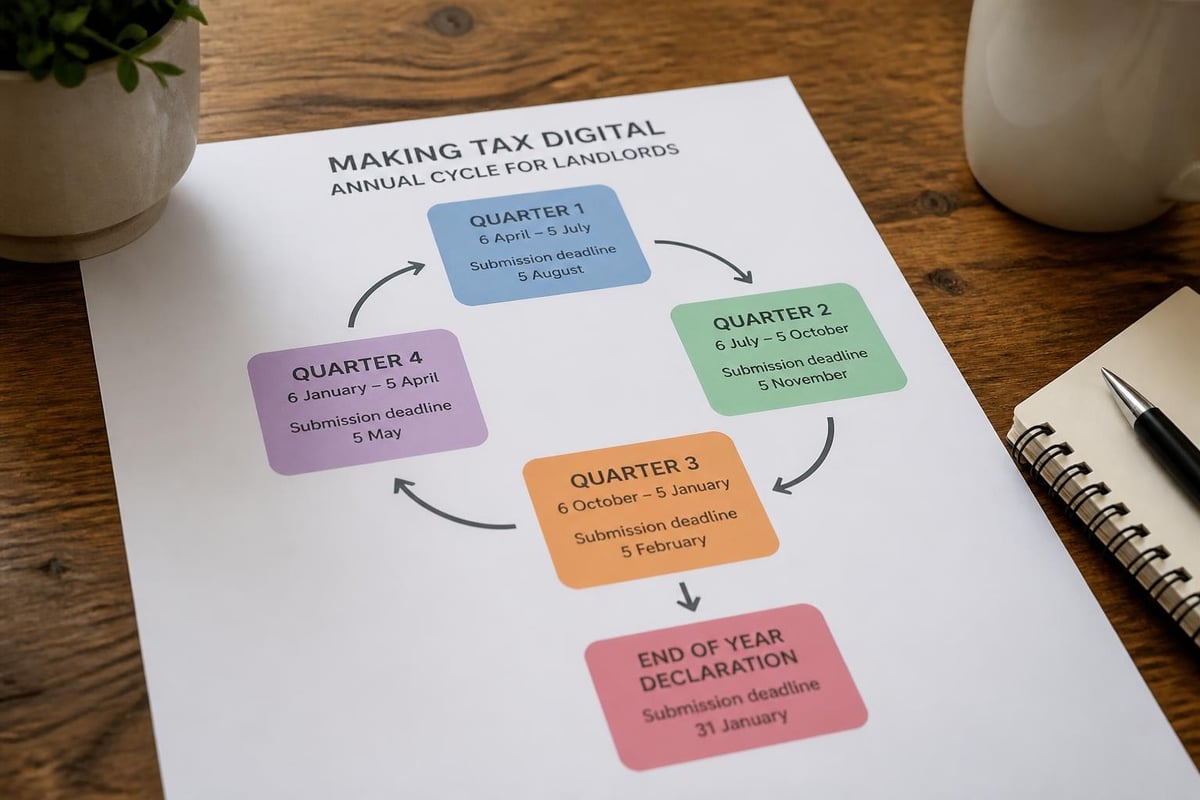
For Phase One landlords, the first quarterly period runs from 6 April 2026 to 5 July 2026. Your update for this period must be submitted through MTD-compatible software by the deadline, typically within a month of the quarter end.
Quarterly Reporting Schedule
Once you're within the MTD regime, you'll follow a set quarterly reporting pattern. These aren't tax payments (you still pay through Self Assessment), but digital updates of your income and expenses.
The four quarterly periods align with the tax year:
Quarter 1: 6 April to 5 July
Quarter 2: 6 July to 5 October
Quarter 3: 6 October to 5 January
Quarter 4: 6 January to 5 April
Each quarterly update must be submitted within one month of the quarter ending. Missing these deadlines can result in penalties, so maintaining accurate digital records throughout the year becomes essential rather than optional.
Choosing MTD-Compatible Software
Meeting the making tax digital landlords deadline requires selecting software that HMRC recognises as compatible with their systems. You cannot use basic spreadsheets or manual record-keeping alone, even if you keep them on a computer.
MTD-compatible software must be able to:
Digitally record all your rental income and allowable expenses
Calculate your profit or loss for each quarter
Submit quarterly updates directly to HMRC via their API
Submit your end-of-year statement
Preserve a digital audit trail of all records
The National Residential Landlords Association guidance provides resources on software options specifically designed for private landlords. When evaluating software for your HMO portfolio, consider whether it handles multiple properties, tracks room-by-room income, and manages the compliance requirements that come with HMO licensing.
For landlords managing HMOs, software that integrates rent collection, compliance tracking, and MTD reporting offers significant efficiency advantages. Rather than maintaining separate systems for different aspects of property management, integrated solutions ensure your rental income data flows directly into your tax reporting.
Managing compliance certificates alongside your financial records becomes particularly valuable for HMO landlords who must track multiple safety obligations. Having certificate management for property integrated with your accounting software means renewal dates and costs feed directly into your tax records.
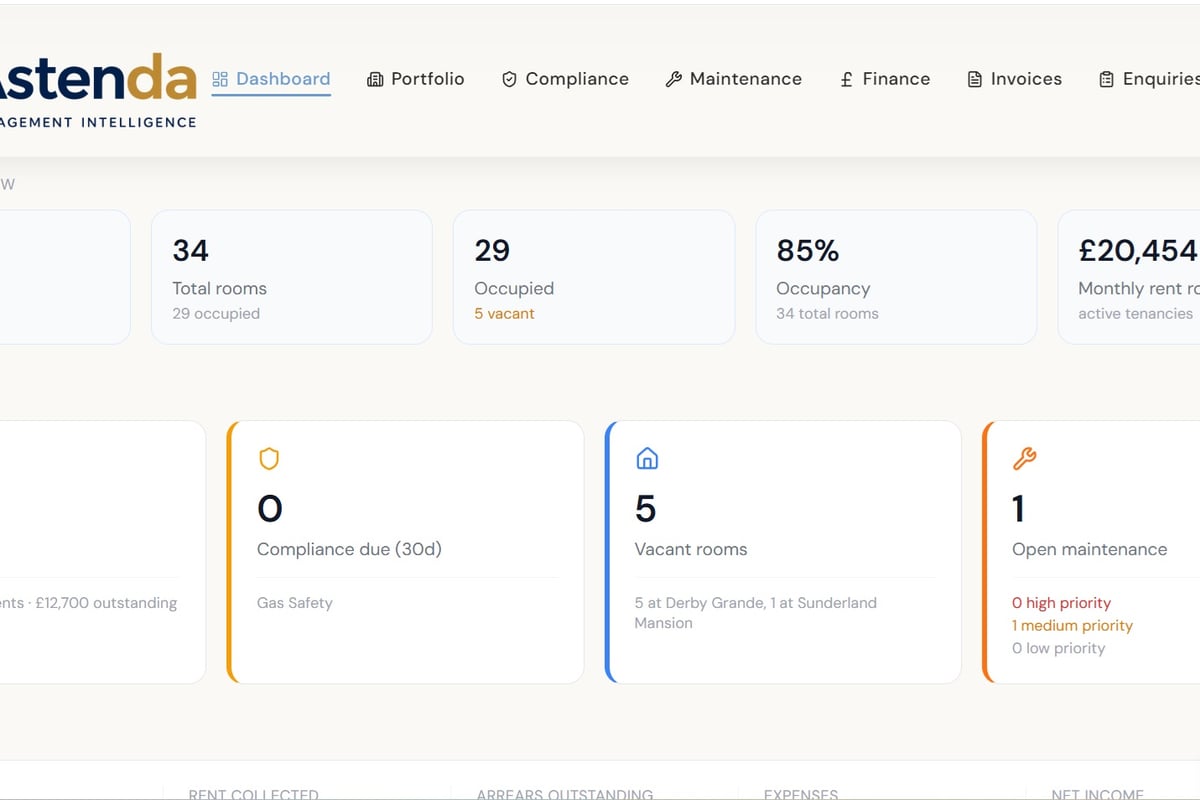
Astenda's platform was specifically built to help HMO landlords manage these connected requirements. With MTD-ready accounting features alongside rent collection and compliance tracking, you can prepare for the making tax digital landlords deadline whilst simplifying your day-to-day property management.
Digital Record-Keeping Requirements
The making tax digital landlords deadline isn't just about submitting quarterly updates. It fundamentally changes how you must maintain your property business records throughout the year.
What Must Be Recorded Digitally
HMRC's requirements under The Income Tax (Digital Obligations) Regulations 2026 specify that landlords must keep digital records of:
All rental income received from tenants
Dates when income was received
Allowable expenses and the dates incurred
Details of the person or business each transaction relates to
A description of each transaction
For HMO landlords, this means tracking income room by room and property by property. If you have five rooms across two HMOs, your system needs to record which rent relates to which room and which property.
The records must be kept digitally from the beginning. You cannot write receipts on paper and transfer them to digital format later, as this breaks the digital link HMRC requires. All transactions must be captured digitally from the point they occur.
Acceptable Digital Methods
You have flexibility in how you capture initial transaction data, provided it creates a digital record:
Photographs of receipts uploaded to MTD software
Digital receipts forwarded from email to your software
Bank feeds that automatically import transactions
Data entered directly into MTD-compatible software
Digital invoices imported from your rent roll system
Many HMO landlords find that using rent roll software that connects to their MTD accounting creates the most efficient workflow. Rent payments automatically create the necessary digital income records without manual re-entry.
Preparing for Your MTD Deadline
With the first making tax digital landlords deadline approaching in April 2026 for higher-income landlords, preparation should begin well in advance. Waiting until the last moment increases stress and the risk of errors.
Step 1: Calculate Your Gross Rental Income
Review your rental income for recent tax years to determine which phase you fall into. Remember to use gross income before expenses.
Step 2: Research and Select Software
Allocate time to evaluate different MTD-compatible options. Consider requesting demonstrations and trial periods. ICAEW's MTD resources provide additional guidance on software selection from an accounting perspective.
Step 3: Migrate Your Records
Transfer your existing property and tenant data into your chosen software. Ensure historical data is accurate, as this forms the baseline for your MTD reporting.
Step 4: Establish Digital Processes
Create new workflows for capturing all transactions digitally from the start. Train anyone who helps with your property management, whether that's a partner, assistant, or bookkeeper.
Step 5: Run Practice Quarters
Before your mandatory start date, run through several practice quarterly periods. This helps identify any gaps in your process whilst you can still make corrections without penalty.
Step 6: Engage Professional Support
Consider whether you need an accountant or tax advisor, particularly for your first year under MTD. The ACCA's agent toolkit can help you understand what support you might need.
Common Challenges for HMO Landlords
The making tax digital landlords deadline presents specific challenges for those running houses in multiple occupation. Understanding these in advance helps you plan effective solutions.
Multi-Room Income Tracking
Unlike single-let properties, HMOs generate income from multiple rooms. Your MTD software needs to track this granular detail whilst rolling it up for quarterly reporting. Systems designed for single-property landlords may struggle with the complexity of multiple concurrent tenancies.
Consider how you'll record:
Different rent amounts for different room sizes or standards
Varying tenancy start and end dates across rooms
Part-month rent calculations when tenants move mid-month
Deposits held and returned for individual rooms
Bills-Included Arrangements
Many HMO landlords include utilities and internet in the rent. Under MTD, you need clear records showing that these included services are part of your rental income, with corresponding expense claims for the actual utility costs.
Avoid the temptation to net these off. Record the full rent as income and claim the actual bills as expenses, maintaining separate digital records for each.
Maintenance and Repair Expenses
HMOs typically generate higher maintenance costs than single lets. Tracking which expenses relate to which property becomes crucial, especially if you're managing multiple HMOs.
Your rental maintenance management process should create digital records at the point expenses occur. Photographs of invoices, digital approval workflows, and automated expense categorisation all help meet MTD requirements whilst reducing administrative burden.
Licensing and Compliance Costs
HMO licensing fees and mandatory compliance costs (gas safety, electrical inspections, fire safety equipment) are allowable expenses. Your digital record-keeping must capture when these costs are incurred and link them to the specific property.

What Happens If You Miss the Deadline
The making tax digital landlords deadline is mandatory once you meet the income thresholds. HMRC has penalty provisions for landlords who fail to comply with their MTD obligations.
Potential consequences include:
Penalties for late submission of quarterly updates
Penalties for inaccurate information in updates
Penalties for failing to keep adequate digital records
Interest charges on any tax paid late
Increased scrutiny of your tax affairs
HMRC has indicated they will take a supportive approach in the early stages of MTD rollout, particularly for genuine technical issues or first-time mistakes. However, this doesn't mean the requirements are optional.
The key to avoiding penalties is starting early, maintaining consistent digital records, and submitting updates on time. If you do encounter problems, contact HMRC promptly rather than ignoring the issue.
Exemptions and Special Circumstances
Whilst most landlords above the income thresholds must comply with the making tax digital landlords deadline, some exemptions exist for specific circumstances.
You may be exempt from MTD if you meet certain criteria related to age, disability, religious beliefs, or location (living abroad with no internet access). HMRC assesses exemption applications individually.
Additionally, if your circumstances change during a tax year such that your rental income drops below the threshold, you may be able to exit MTD for future years. However, you cannot simply leave the system mid-year once you've started.
Temporary absences from the UK don't automatically exempt you. The Which? guidance on tricky MTD questions addresses common scenarios landlords ask about regarding exemptions.
Integration with Existing Property Management
For HMO landlords, the making tax digital landlords deadline provides an opportunity to streamline property management processes rather than just adding another administrative burden.
Integrated property management platforms that combine rent collection, compliance tracking, and MTD-ready accounting offer significant advantages:
Traditional Separate Systems | Integrated Platform |
|---|---|
Manual data re-entry between rent records and accounts | Automatic flow from rent collection to MTD records |
Risk of discrepancies between systems | Single source of truth for all data |
Multiple software subscriptions | One platform for all management needs |
Separate training and learning curves | Unified system to learn |
Difficult to see complete financial picture | Holistic view of portfolio performance |
When rent payments flow automatically into your digital accounting records, you eliminate double-handling and reduce errors. Similarly, when expense records for maintenance and compliance create accounting entries automatically, your quarterly updates become straightforward summaries rather than complex reconciliation exercises.
The most effective preparation for MTD involves choosing systems that reduce administrative work rather than adding to it.
Looking Beyond the Initial Deadline
Whilst meeting the making tax digital landlords deadline is your immediate priority, understanding HMRC's longer-term vision helps you prepare for future changes.
Over time, HMRC intends to:
Potentially reduce or eliminate the separate Self Assessment return
Provide real-time tax position calculations based on your quarterly updates
Enable more immediate tax payment options aligned with actual income
Reduce year-end reconciliation complexity
For landlords, this could eventually mean your tax affairs are continuously up to date rather than requiring an annual scramble. However, these benefits only materialise if your digital record-keeping is accurate and consistent throughout the year.
Building good MTD habits now positions you to benefit from future simplifications rather than struggling to catch up.
Tax Agent Relationships Under MTD
Many landlords work with accountants or tax agents. The making tax digital landlords deadline doesn't eliminate the value of professional support, but it does change the nature of that relationship.
Your accountant cannot submit quarterly updates without access to your digital records throughout the year. The traditional model where you send a shoebox of receipts once a year no longer works.
Consider these collaboration models:
Model A: Agent-Led Software - Your accountant provides MTD software, and you input data they can access throughout the year.
Model B: Landlord-Led Software - You choose and use your own MTD software, granting your accountant viewing rights or exporting data when needed.
Model C: Shared Platform - You use integrated property management software for day-to-day operations, with your accountant accessing the financial data directly for quarterly submissions and tax advice.
Discuss with your accountant early how they prefer to work under MTD. Their fees may change to reflect quarterly work rather than annual preparation.
Digital Record Retention Requirements
Beyond submitting quarterly updates, the making tax digital landlords deadline includes specific requirements about how long you must retain digital records.
You must keep your digital records for the duration you would normally keep tax records. This means maintaining digital access to all income and expense records, even after you've submitted quarterly updates and end-of-year statements.
For landlords, this creates practical questions:
What happens if your software provider goes out of business?
How do you export and preserve data if you switch software?
Who owns your data and can you access it after cancelling a subscription?
When evaluating MTD software, ask about data export capabilities and long-term data access. Ensure you can extract your complete digital audit trail in a usable format for record retention.
The making tax digital landlords deadline represents a fundamental shift in how you report rental income, with phased implementation beginning in April 2026. Starting your preparation early, selecting appropriate software, and establishing robust digital record-keeping processes will help you meet these new obligations whilst potentially streamlining your property management overall. For HMO landlords managing multiple properties and tenancies, Astenda road-map2027 will offers an integrated approach that combines MTD-ready accounting with the rent collection, compliance tracking, and portfolio oversight you need for efficient day-to-day management.
Get a live view of your whole property portfolio.
Start your 30-day free trialGeneral information only. This is not legal, tax or financial advice. Rules change and vary by council, so check GOV.UK or take professional advice.