Planning Permission HMO: Your 2026 Guide for UK Landlords
Converting a property to an HMO or purchasing one to add to your portfolio requires careful navigation of planning regulations that have become increasingly complex over recent years. Understanding when you need planning permission hmo approval can save you considerable time, money and legal headaches. The landscape changed significantly in 2026, with more councils introducing Article 4 directions and tightening their approach to HMO concentrations. This guide explains the planning framework, when consent is required, and how to approach the application process as a landlord.
Understanding HMO Use Classes and Planning Permission
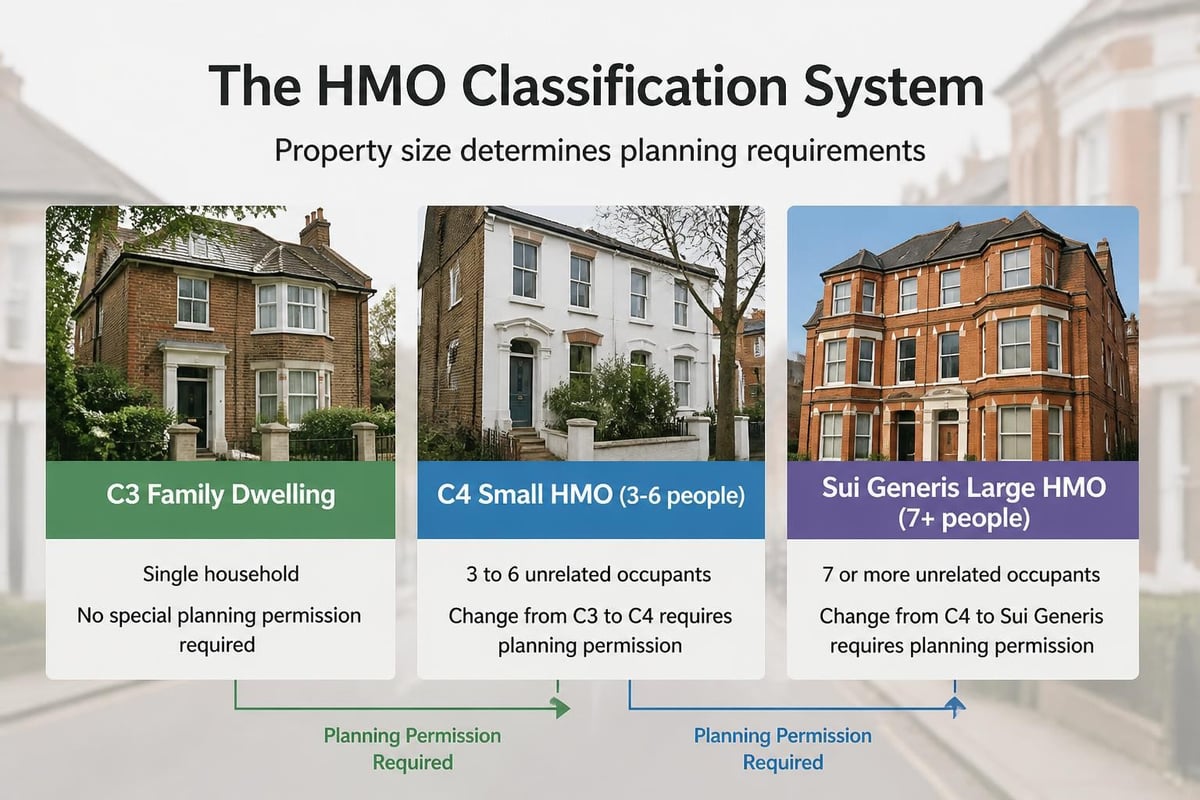
The planning system categorises properties into different use classes, and moving between these classes often triggers the need for planning consent. Standard family homes fall under Class C3 (dwelling houses), whilst HMOs occupy two distinct categories depending on their size.
The Three Planning Categories for HMOs
Small HMOs housing three to six unrelated individuals fall under Class C4. Larger HMOs with seven or more occupants are classified as sui generis, meaning they sit outside the standard use classes entirely. This distinction matters enormously when determining whether planning permission hmo requirements apply to your property.
Converting from C3 to C4 was historically considered 'permitted development' in many areas, meaning no planning application was needed. However, the widespread adoption of Article 4 directions has fundamentally changed this across much of England and Wales.
Key use class transitions:
- C3 to C4: Previously permitted development, now requires planning permission in Article 4 areas
- C3 to sui generis: Always requires planning permission
- C4 to sui generis: Generally requires planning permission
- Any HMO in a dwelling with commercial ground floor: Likely sui generis from the outset
The Planning Portal provides detailed guidance on use classes that helps clarify which category your property occupies and when change of use consent becomes necessary.
Article 4 Directions and Their Impact on HMO Planning
Article 4 directions represent the single most significant planning control affecting HMO landlords in 2026. These local planning tools allow councils to remove permitted development rights, requiring full planning permission for conversions that would otherwise proceed without consent.
The Article 4 Wave Across England and Wales
Recent research shows that Article 4 directions have spread rapidly across UK councils, with the majority of major cities and university towns now operating some form of restriction. Birmingham, Manchester, Leeds, Liverpool, Cardiff, Bristol, Nottingham and dozens of smaller authorities have implemented these controls.
The effect is straightforward: in an Article 4 area, converting a C3 family home to a C4 small HMO requires planning permission hmo approval, even though this would normally be permitted development. The direction doesn't prevent conversions, but it subjects them to planning scrutiny and local policy tests.
Common Article 4 configurations include:
- City-wide blanket directions covering all wards
- Targeted directions in specific wards or neighbourhoods
- Incremental expansion from initial pilot areas
- Directions tied to HMO concentration thresholds in local policy
Dudley Council's HMO Article 4 direction provides a practical example of how local authorities implement and explain these restrictions to landlords and residents.
| Authority Type | Likelihood of Article 4 | Typical Coverage | Policy Driver |
|---|---|---|---|
| Major cities | Very high | City-wide or major wards | Concentration concerns |
| University towns | High | Central and student areas | Balanced communities |
| Coastal towns | Medium-High | Town centres | Housing mix objectives |
| Rural districts | Low-Medium | Selective if any | Limited HMO pressure |
When Planning Permission HMO Consent Is Required
Determining whether you need planning permission depends on three factors: the existing use of the property, the proposed HMO category, and whether Article 4 directions apply in the location.
Mandatory Planning Scenarios
Planning permission hmo approval is always required when converting a C3 dwelling to a sui generis HMO of seven or more occupants. This applies nationwide regardless of Article 4 directions. Similarly, any change from commercial or mixed use to HMO typically requires consent.
In Article 4 areas, you'll also need planning permission for C3 to C4 conversions. Given the prevalence of these directions in 2026, most HMO conversions in urban areas now require formal applications.
If your property already operates as an HMO without the correct planning consent, you face enforcement risk. Councils can issue enforcement notices requiring you to cease the HMO use or apply retrospectively for planning permission. The Planning Inspectorate's appeal decisions demonstrate how enforcement cases are assessed and the weight given to planning harm versus housing need.
When Planning Permission May Not Be Needed
- Existing lawful HMO use: If the property has operated as an HMO continuously for four years or more, the use may be immune from enforcement
- C4 in non-Article 4 areas: Increasingly rare, but some rural and suburban areas retain permitted development rights
- Changes within the same use class: Moving from a five-person C4 HMO to a six-person C4 HMO doesn't change the use class
- Properties already sui generis: Changing occupancy numbers within an existing large HMO doesn't require fresh planning consent
Understanding what constitutes an HMO under government guidance helps clarify when planning controls bite, though remember that planning definitions can differ slightly from HMO licensing definitions.
Local Planning Policy and HMO Thresholds
Beyond use class mechanics, local planning authorities operate policies that set criteria for approving or refusing HMO applications. These policies vary significantly between councils but share common themes around managing HMO concentration and protecting balanced communities.
Concentration Thresholds and Buffer Zones
Many councils specify maximum HMO concentration thresholds within defined areas. Common approaches include percentage limits within radius measurements or ward-level caps. For example, a policy might state that HMOs should not exceed a certain percentage of properties within a specified distance of the application site.

Portsmouth's HMO planning guidance provides a detailed example of how Supplementary Planning Documents set out local thresholds, material considerations and assessment criteria that planning officers use when determining applications.
Typical material planning considerations include:
- Existing HMO concentration in the immediate area
- Impact on residential character and amenity
- Parking provision and traffic generation
- Garden and amenity space adequacy
- Refuse and recycling storage arrangements
- Noise and disturbance potential
- Demand for family housing in the locality
The balance landlords must strike involves demonstrating that the HMO meets local policy tests whilst addressing genuine planning concerns. Applications that fail concentration thresholds face refusal unless material considerations outweigh the policy breach.
Preparing and Submitting Your Planning Application
When planning permission hmo consent is required, thorough preparation significantly improves approval prospects. The application process demands attention to local policy requirements, technical details and neighbour concerns.
Essential Application Components
Standard requirements for HMO planning applications:
- Completed application forms via the Planning Portal
- Site location plan (typically at scale showing the property boundary)
- Floor plans showing existing and proposed layouts
- Design and access statement explaining the proposal
- Supporting statement addressing local HMO policy criteria
- Payment of the appropriate planning fee
The supporting statement represents your opportunity to make the planning case. Address concentration calculations directly, explain management arrangements, demonstrate parking compliance and show how the proposal aligns with local policy objectives.
Addressing Common Objection Grounds
Neighbour objections frequently cite parking pressure, noise concerns, refuse accumulation and character change. Your application should proactively address these through evidence and management commitments.
Demonstrating professional property management helps counter concerns about neglect and anti-social behaviour. If you manage compliance obligations systematically using property management software like the Landlord Founding Package, you can reference this in your supporting statement to show you take tenant management and property standards seriously. This can strengthen your application by addressing officer and neighbour concerns about responsible operation.
| Application Element | Purpose | Common Mistakes to Avoid |
|---|---|---|
| Supporting statement | Make the planning case | Generic templates, ignoring local policy |
| Concentration calculation | Show compliance with thresholds | Inaccurate radius, missing HMOs from count |
| Management plan | Address amenity concerns | Vague commitments, no enforcement detail |
| Parking assessment | Demonstrate adequate provision | Ignoring local standards, no cycle storage |
| Floor plans | Show room sizes and facilities | Unclear layouts, missing dimensions |
Navigating Consultation and Determination
Once submitted, planning applications enter a statutory consultation period during which neighbours, ward councillors and statutory consultees can comment. This process takes a minimum of several weeks and can extend to several months for complex or controversial cases.
The Consultation Period and Neighbour Responses
The council notifies nearby properties and posts a site notice. Neighbours have a window to submit representations supporting or objecting to the proposal. Objections based on material planning considerations carry weight; concerns about property values or personal circumstances do not.
Planning officers assess the application against local and national policy, balancing the representations received. The National Planning Policy Framework sets the national context, emphasising the importance of housing supply whilst allowing councils to apply local restrictions where justified.
Your response options to objections include:
- Submitting additional information to address specific concerns
- Amending the proposal to overcome objections
- Requesting a meeting with the planning officer
- Preparing to speak at committee if the application is called in
Most applications receive delegated decisions from planning officers. Contentious cases may go to planning committee, where councillors make the final determination after hearing representations.
Conditions, Refusals and Appeals
Approved applications often carry planning conditions restricting occupancy numbers, requiring management plans or limiting certain activities. These conditions bind the property, not the individual landlord, and transfer with ownership.
If refused, you have the right to appeal to the Planning Inspectorate. Appeals involve submitting detailed grounds explaining why the council's decision was incorrect, with the inspector considering planning policy, precedent and material considerations afresh. The process typically takes several months and success rates vary considerably depending on the strength of your case and local policy compliance.
The Relationship Between Planning Permission and HMO Licensing
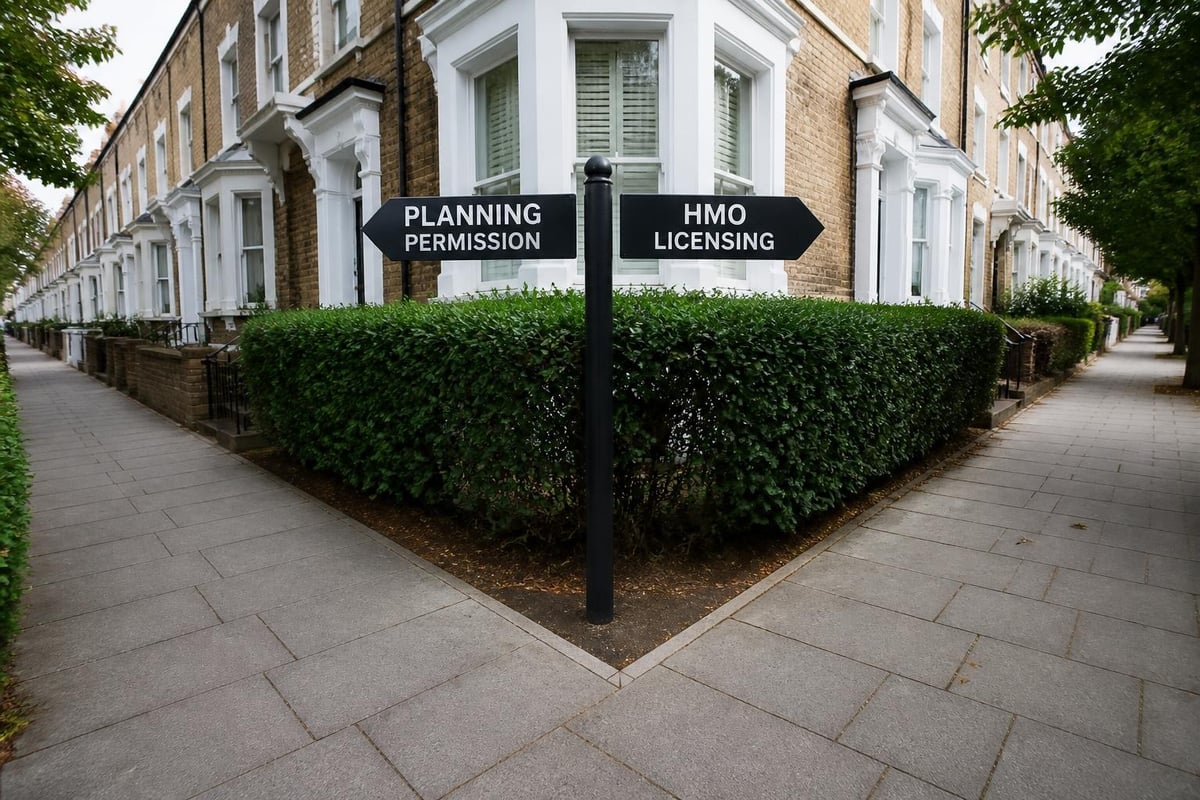
A common source of confusion involves the distinction between planning permission hmo requirements and HMO licensing obligations. These are separate regulatory regimes administered by different council departments, though both may apply simultaneously.
Two Parallel Consent Regimes
Planning permission concerns land use and its impact on the surrounding area. HMO licensing addresses property standards, management and occupant safety. You can hold a valid HMO licence without planning permission, though operating without the necessary planning consent risks enforcement action.
Conversely, planning permission doesn't guarantee a licence will be granted. The HMO licensing system applies separate tests around safety standards, management competence and property suitability.
Key differences between the regimes:
| Aspect | Planning Permission | HMO Licensing |
|---|---|---|
| Administered by | Planning department | Private housing/licensing team |
| Considers | Land use impact, concentration | Safety standards, management fitness |
| Duration | Permanent (unless time-limited) | Typically five years renewable |
| Appeal route | Planning Inspectorate | First-tier Tribunal (Property Chamber) |
| Primary concern | External amenity and character | Internal standards and tenant welfare |
Securing planning permission before applying for an HMO licence makes logical sense, as the licence application may be refused if planning consent is absent. However, councils cannot refuse a licence solely on planning grounds if the planning breach is under appeal.
Managing both sets of compliance obligations requires systematic record-keeping. Tools that help you track property compliance certificates and renewal dates ensure nothing lapses whilst you're navigating planning processes.
Strategic Considerations for Portfolio Landlords
If you operate multiple HMOs or plan to expand your portfolio, planning permission hmo strategy becomes a critical business consideration. The direction of travel in 2026 suggests planning controls will tighten further rather than relax.
Assessing Acquisition Opportunities
Before purchasing a property for HMO conversion, verify whether Article 4 directions apply and research local HMO concentration levels. Properties in saturated areas face higher refusal risk regardless of their individual merits.
Due diligence checklist for HMO acquisitions:
- Check Article 4 coverage on the local authority planning website
- Calculate existing HMO concentration using council records
- Review recent HMO planning decisions in the ward
- Assess parking provision against local standards
- Verify the property's current lawful use
- Consider proximity to existing HMOs and sensitive uses
Properties already operating lawfully as HMOs often command premium prices precisely because planning permission is already secured. Purchasing these can prove more cost-effective than fighting difficult planning battles, particularly in areas with restrictive policies.
Building Relationships with Planning Departments
Experienced HMO landlords often engage in pre-application discussions with planning officers before submitting formal applications. These consultations provide informal steer on likely outcomes and allow you to address concerns early.
Pre-application advice typically incurs a fee but can save considerably more by avoiding refusals or protracted negotiations. Officers may suggest design amendments, management commitments or supporting evidence that strengthen your case materially.
Future-Proofing Your HMO Business Against Planning Changes
The planning landscape for HMOs continues evolving, with councils responding to local housing pressures and community concerns. Staying informed about policy changes in your operating areas helps you anticipate challenges and opportunities.
Monitoring Local Plan Reviews and Policy Consultations
Local authorities periodically review their Local Plans, which set planning policy for ten to fifteen-year periods. These reviews often introduce new HMO policies, adjust concentration thresholds or extend Article 4 coverage.
Responding to planning policy consultations allows you to input landlord perspectives before policies are adopted. Industry bodies and landlord associations increasingly coordinate consultation responses to ensure practical housing supply considerations are heard alongside resident concerns.
The Town & Country Planning Association's policy reviews provide national context on how permitted development and Article 4 approaches are debated at policy level, helping you understand the wider forces shaping local decisions.
Diversification and Compliance as Risk Management
Holding properties across multiple local authority areas reduces exposure to any single council's planning restrictions. Similarly, maintaining properties in various HMO categories (C4 and sui generis) and size bands spreads regulatory risk.
Rigorous compliance across all your obligations strengthens your position when applying for planning permission. Councils consider management track records when assessing applications, with enforcement histories or licensing breaches potentially counting against you.
Systematic approaches to landlord tax obligations and other regulatory requirements demonstrate professional operation that supports planning applications. Officers are more likely to recommend approval when satisfied the landlord will maintain high standards.
Common Planning Permission HMO Mistakes and How to Avoid Them
Even experienced landlords encounter pitfalls when navigating planning processes. Learning from common errors saves time, money and frustration.
Operating Without Checking Planning Status
The most serious mistake involves converting or operating an HMO without verifying whether planning permission is needed. Assumptions that permitted development rights exist or that planning permission isn't necessary can prove costly.
Enforcement consequences may include:
- Enforcement notices requiring cessation of HMO use
- Retrospective planning applications under time pressure
- Prosecution for non-compliance with enforcement notices
- Inability to obtain or renew HMO licences
- Mortgage issues if lenders discover planning breaches
- Reduced property value due to uncertain planning status
If you discover you're operating without necessary planning permission, seek professional planning advice immediately. In some cases, the use may have become lawful through time, or retrospective permission may be obtainable.
Inadequate Research and Application Preparation
Submitting poorly prepared applications wastes fees and time whilst creating a negative record. Planning officers remember substandard applications and may scrutinise future submissions more critically.
Invest appropriate time understanding local policy, calculating concentrations accurately and addressing likely objections proactively. Professional planning consultants can prepare applications if you lack confidence, with fees often justified by improved approval prospects.
Ignoring Neighbour Concerns and Community Relations
Dismissing neighbour objections as nimbyism misses opportunities to address legitimate concerns and build goodwill. Well-managed HMOs with considerate landlords generate fewer complaints and smoother planning processes.
Simple measures like introducing yourself to neighbours, explaining your management approach and providing contact details for concerns demonstrate professionalism. These relationships can result in neutral representations rather than objections when planning applications are consulted.
Practical Tips for Successful Planning Applications
Success in securing planning permission hmo approvals often comes down to attention to detail, understanding local context and presenting a compelling case aligned with planning objectives.
Strengthening Your Application Through Evidence
Supporting your application with evidence rather than assertions makes planning officers' jobs easier and improves outcomes. Where concentration is borderline, present detailed calculations showing compliance. Where parking is constrained, evidence public transport accessibility and low car ownership among typical tenants.
Evidence types that strengthen applications:
- Concentration surveys: Accurate counts of existing HMOs within policy radius
- Parking surveys: Demonstrating available on-street capacity at relevant times
- Management plans: Detailed commitments on refuse, maintenance and tenant conduct
- Demand evidence: Local housing needs assessments or waiting list data
- Character appraisals: Showing the HMO fits the street's existing character
- Precedent decisions: Highlighting similar approvals in the area
Professional presentation matters. Clear plans, well-written statements and comprehensive supporting documents signal serious intentions and professional operation.
Timing and Strategic Patience
Submit applications when you can wait for determination without financial pressure. Rushed applications submitted before purchase completions or licence renewals often result in poorly prepared cases or acceptance of unfavourable conditions.
If initial feedback suggests likely refusal, consider whether withdrawing and resubmitting an improved application preserves your appeal rights. Refused applications create a negative record and consume appeal rights, whereas withdrawn applications allow you to try again with stronger cases.
Monitor planning committee dates and local political cycles. Avoiding controversial submission timing around elections or when HMOs are receiving negative press coverage can reduce political pressure on marginal decisions.
Professional Support and When to Engage It
Straightforward applications in permissive areas may not require professional planning consultants. Complex cases, appeals or contentious locations often benefit from expert input.
Planning consultants bring local knowledge, relationships with planning officers and experience with similar cases that improve approval prospects significantly. Fees vary but typically represent a fraction of the cost of refused applications or lost rental income from delayed conversions.
Similarly, legal advice becomes valuable if facing enforcement action or considering appeals. Specialist planning barristers can represent you at inquiries or hearings where technical planning law arguments determine outcomes.
Navigating planning permission hmo requirements demands careful attention to use classes, Article 4 directions and local planning policy whilst maintaining professional standards across all your compliance obligations. As the regulatory landscape continues evolving in 2026, staying informed and approaching planning strategically protects your investment and supports sustainable portfolio growth. Astenda helps HMO landlords manage their compliance, licensing and operational obligations systematically, giving you the organised foundation that supports successful planning applications and professional property management across your portfolio.
Get a live view of your whole property portfolio.
Start your 30-day free trialGeneral information only. This is not legal, tax or financial advice. Rules change and vary by council, so check GOV.UK or take professional advice.